

burberry forward: lessons learnt
a brand trying to win back its customers with two opposing briefs


Heritage is the most recognisable thing a brand can sell. Credibility is the hardest to maintain and the most expensive to borrow. Burberry’s bounce-back story shows us how two opposing briefs can work without cannibalising each other.
~~~~
In 2024, Joshua Schulman joined Burberry as CEO. At the time, it was one of the most troubled brands in luxury fashion: profit warnings and a share price that had dropped by 40%. Over 18 months later, Burberry reported a return to growth in its FY26 results. Could this be one of Britain’s best brand comeback stories? By any financial metric, Schulman’s ‘Burberry Forward’ strategy has been a success.
Any rebrand is difficult. Particularly for a heritage brand in a landscape of declining global sales. Joshua Schulman has a reputation for transforming luxury brands (Coach, Michael Kors, Jimmy Choo).
There have been a few luxury rebrands in recent years and not all of them have been positively received (read: Jaguar), so here’s a look at what the Burberry Forward plan entailed, and what can be learnt from it - as a marketer and a creative commissioner.
what changed at burberry?
A lazy analysis of this will define this as a redemption story. A heritage brand loses its way, a new CEO joins and returns it to its roots and voila the numbers recover. Whilst it is true, it’s an incomplete picture. ‘Returning to its roots’ wasn’t just a creative decision by Daniel Lee; it was a choice about which audience the brand would cater to.
Schulman joined Burberry and condensed the problem in a single phrase: the brand had drifted into a ‘niche aesthetic’ and the product ‘skewed to a narrow base of luxury customers’. Reading that as a marketer: he’s referring to the reach rather than the taste behind it. The previous strategy - shift upmarket, raise the price of leather goods and lean into seasonal fashion - had made Burberry appealing to a smaller, fashion ‘purist’ audience whilst alienating the much larger one who simply want a recognisable British trench coat. Schulman undid this, with a brief for broad appeal: make the brand instantly recognisable again, to as many people as possible in the markets that pay. Heritage is the most globally recognisable asset Burberry owns, and he doubled down on this.
There have been a lot of media reports about this in recent months and here’s what’s missed from a lot of them: Daniel Lee hasn’t left. He joined as creative director in 2022 and is still there. His Burberry is about cultural credibility and that hasn’t left. One of his campaigns cast Skepta, Raheem Sterling, Shygirl and John Glacier. A Britishness represented by grime, football and London ‘cool’. His summer 2026 campaign still blends music and fashion, as he says: ‘music pushes boundaries, blurs lines and defines the codes of fashion.’
What’s happening is there are two briefs running simultaneously since Schulman joined, and they’re both in place to achieve entirely different things. There’s Lee’s credibility ambition which follows one of the oldest playbooks in the game - borrow credibility from the right footballer, music artist or postcode. Then it’s juxtaposed with Schulman’s commercial brief, which champions the heritage product. With a specific goal to regain customers in Asia.
Two briefs, two goals and intentions. Which one did the heavy lifting for +2% FY growth?
a tale of two briefs
Cultural credibility and commercial viability are often in competition with one another in the briefing room. Burberry’s turnaround story has arguably demonstrated which one has the real power. Schulman’s answer to this debate was unambiguous: when recognisability and credibility conflict, the former pays the rent. The numbers back that up - a credible brand can’t sustain itself when you’ve priced and narrowed it into irrelevance. That logic can be applied elsewhere, like music. Mariah Carey entered her Glitter era with one of the most recognisable catalogues in commercial pop, then she pivoted to a project with a retro R&B sound and hip-hop features. It didn’t connect in the same way and has since been pulled from digital platforms. One external challenge to note is that it was released the same day as the 9/11 attack. Her next project, ‘Emancipation of Mimi’, recovered her lapsed audience not by being more interesting and specific, but by returning to her pop roots and becoming palatable to a mainstream audience again. It’s the same brief as Schulman applied in a different context.
Returning to luxury fashion, Wales Bonner and Martine Rose built their brands the other way around - credibility first. The brands scaled from a specific cultural point of view, rather than introducing it after an audience has been established.
lessons learnt
Here’s what I’ve taken from this, for any brand with heritage and legacy as an available asset. The first thing to decide on is whether this brief is selling recognisability or credibility.
Burberry’s transformation so far has proven that heritage and familiarity can help you to recover an audience which may have been lost. However, when Burberry’s largest financial gains are in Asia and China more specifically, the impact of licensing credibility from talent is still a little more opaque right now.
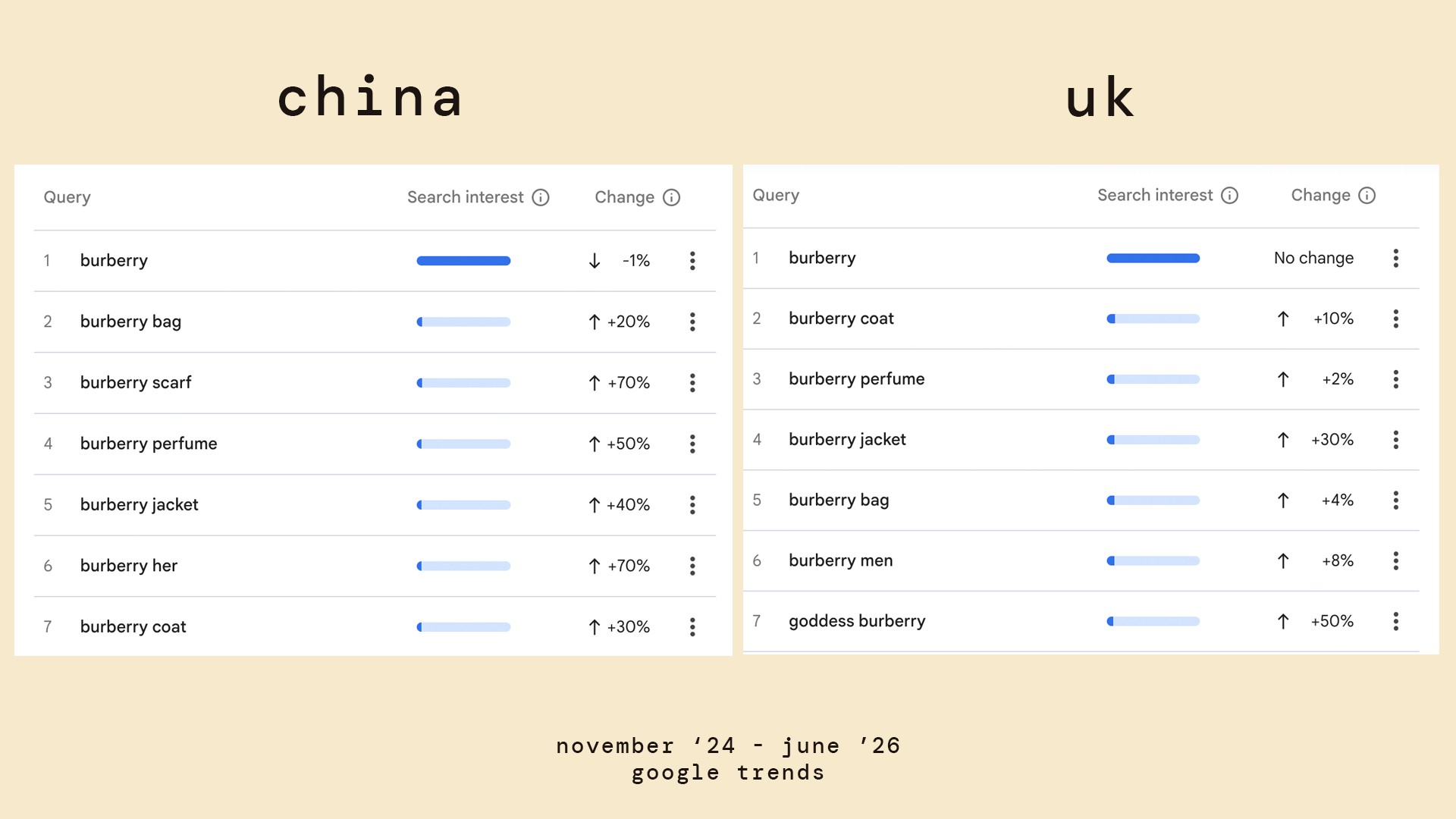
One question I’ve often struggled with in conversations with some clients is the metric for cultural credibility, as this isn’t comparable to traditional advertising formats. Instead, I’ve looked at what Google Trends tells us. It’s not a measure of conversion but it does reflect intent. In China, the fast-growing queries are product searches - recognisability driving search. In the UK it’s a different picture. The main search is ‘goddess burberry’ which is tied to Lee’s creative direction - that’s the credibility work. Two briefs, two audiences and two search behaviours, which means the data legitimises both briefs.
If Schulman’s recognisability caters to an Asian audience, whilst Lee’s credibility is doing the work in the UK, both supplement each other. One stays rooted in the place where it was born, and the other finds the consumers who want to invest.
The move isn't to choose between recognisability and credibility. It's to brief them separately, for separate audiences, toward separate goals. All it needs is a specific audience for each brief, and the discipline not to let them bleed into each other.
in house favourites:
throughout june, join me for my 30-day series called Crash-Out
the dying art of music marketing
culture and zeitgeist aren’t the same thing
the commercial value of taste
are we losing the capacity for independent thought?
sudan: what she said, and what happened next
collective power is how to win in creative
You really do your research! 👏